Incendiary Imbeciles #15
by Letter Burn
We entered the Queen's antechamber from the north and walked down the gentle slope while her great great great grandchildren mobbed us. So full of vitality and joy in their young lives, a slight breeze waggled their foliage and gave them voices. Their rushing clamor sounded like mocking jeers, derision, and hexing chants. They pressed against us and clutched at our Nomex clothes and firepacks giving us a feeling of being thronged by street urchins in an ancient city. Perhaps fearing pickpockets, we furtively felt for our wallets. But also we kept our eyes peeled for hidden smoldering spot fires.
We had been sent as reinforcements to a Smokejumper Base in Northern California, and dispatched to this fire in the Trinity Alps. The vistas from the airplane conjured images of a beautiful Shangri la with glorious alabaster marble buttes, tall graceful glamorous conifers, and no doubt a stunning enchanted forest below. At the wildfire, we gingerly cast a fireline around the perimeter of the fingerly fire. Mop up proved even easier. Oddly, some smoldering spots seemed to merge and be absorbed by the forest litter duff, yielding a cool, sooty crust that looked and smelled like scrumptious pastries.
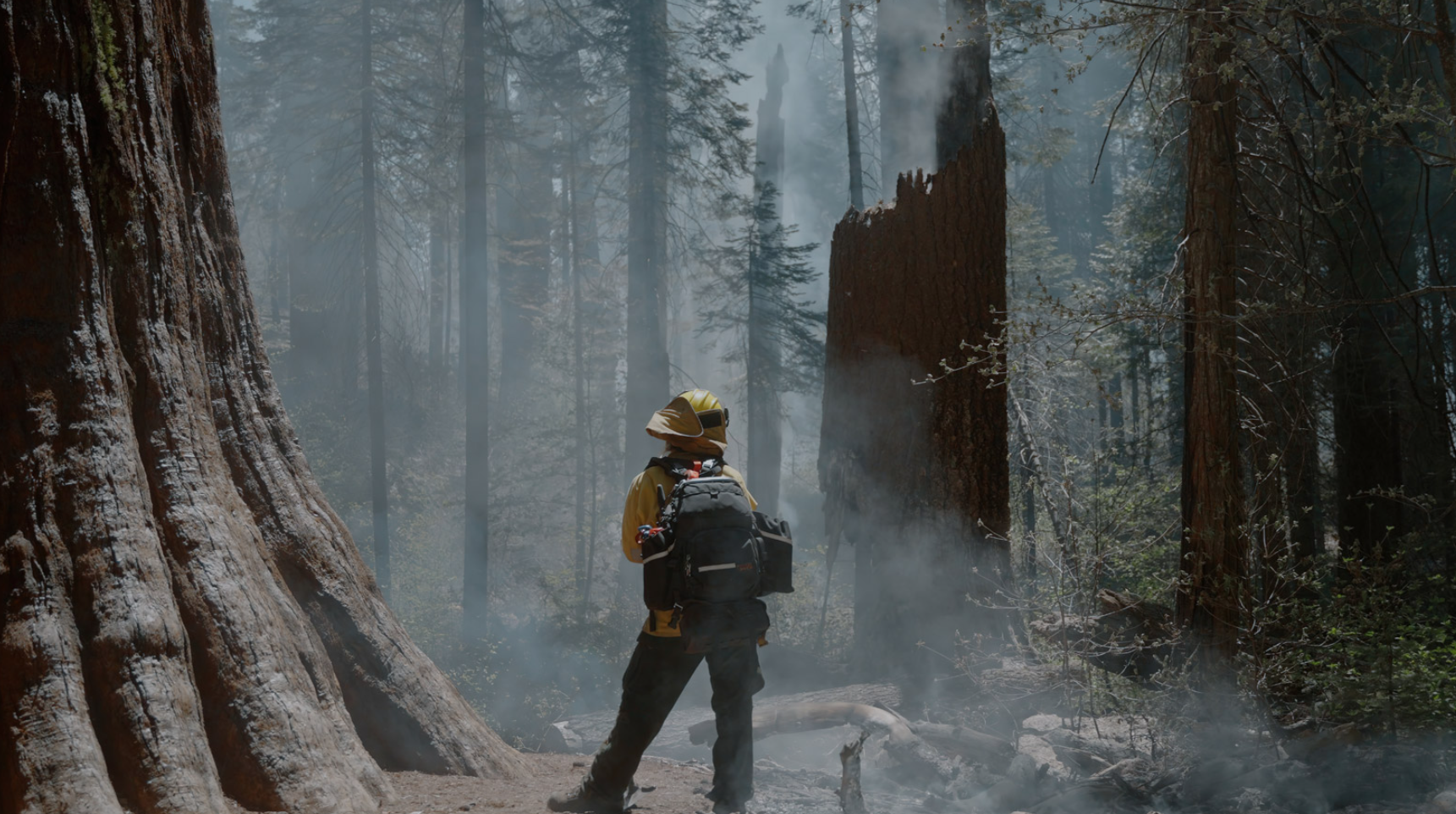
Photo Credit: Save the Redwoods
Soon we commenced wrapping up the fire. But we still had the problem of the Big Smouldering Snag. Or the "Queen of the Fairy Forest” as Rob our resident forester called her. Protocol, based on an unproven conjecture, assumed a smoldering snag would waft out embers that will surly start a reburn. So smoldering snags should be cut down. Or, if it’s too dangerous to fell, then a couple of firefighters could monitor the smoldering snag until it burns itself out.
Back on our spotfire search-and-destroy mission, as we walked further past the thronging small tree thickets, called “reprod” by firefighters, we encountered the Queen’s realm of cheeky teenage great great grandchildren. When we tried to push through the thick throng the sad, scrawny, scruffy misfits easily slid off. But more often, hulking bullies barred the way and challenged each of our intruding steps.
Next, we came across her great grandchildren, standing in a more spacious marketplace. Some, dressed in ragged tattered foliage, seemed weak, craven, and malnourished. Others appeared as prosperous, stout merchants. They paid no attention to us and kept their heads toward the sky as they extracted tiny bits of carbon and calculated its worth. Would they add it to their own girth or would they take it through their roots to the underground trade where they’d sell off their manufactured sugars and exotic chemicals to subterranean microbial mongers and bargain successfully for a few rare elements?
A scatter of strides more took us to a thinned out area. Gone were the living but wretched, out-competed trees. Here cringed the corpses of copses of failed trees. Desiccated and faded, some splayed on the ground. Perhaps they remain remnants of ancient battles against wildfires. But just as likely they lay as losers in the constant battle of attrition for resources of light, water, and soil nutrients.
Beyond stood the Sentries, tall and strong, their bark riveted like armor protecting them and their grandmother, the queen. They had successfully shaded out competitors. They had undoubtedly dropped a drip of needles on the shrubs creeping in below. Now even a low intensity wildfire would burn these resource hungry interlopers back to marginal harm.
Further beyond, stood the Centurians. Tallest and magnificent. The oldest prodigy of the Queen. Their foliage thrives fathoms away from any chance of being ignited by tender below. They shaded the expanse beneath. And there prospered a cornucopia of plant diversity. The old queen had welcomed multifarious factions of fabulous species to live in her garden beneath her family’s canopy. For hundreds of years the Centurions had protected, consoled and counseled their mother the Queen. They stood in a spacious parklike expanse with abiding, unobtrusive flowering shrubs and wildflowers. These living ornaments vouched the sacred chamber of the Queen. And the biome even coddled her in her standing death because she yet had many nurturing tasks and incubated many molecular treasures deep in her slowly decaying xylem. So the Centurians watched over her and scanned the heavens for rain and lightning, intuitively determining the coming boon or approaching stress. They influenced the subterranean underground trade so that symbionts thrived and pathogens gnawed only at the edges.
As we approached the snag and began to grasp her awesome presence, Rob, seemingly now her oracle, appeared. He solemnly related how this Sugar Pine snag, the queen, had lived for centuries and has stood dead for decades, providing food for woodpeckers, and homes for generations of birds, bats, and squirrels. He pointed to her broken top, jagged with spikes, now looking like a crown, proving she had been taller, perhaps tallest in the forest. He praised her girth as being the widest we had seen here. When a radiant ashen skeleton of lichen peeled off up high and slowly drifted away, luminously sparkling like a glowing ashen Colman lantern mantle, Rob proclaimed that this noble snag remained capable of magic.
Several flames adorned her trunk, shimmering like far off cauldrons pulsating in adoration of their fire-forged creations. More likely they mundanely cooked ancient squirrel nests and burned the cash of hoarded pine nuts. The old snag would occasionally spit out cinders barraging like rifle shots. The embers would slowly drift and dance for a few seconds in the little puffy breeze. They winked at us then drained dead out. Cold, cold like the faraway stardust from whence they came billions of years ago. They echoed the stars we viewed at night that may oversee their own secret alien thriving ecosystems.
“I know you’ve come to fell the snag.” Rob said. “But you don’t need to do that. I will stay here and monitor the snag and make sure her embers don’t start any reburns. Her fire scars seem to show that she burned frequently through the ages in a few spots that rapidly go out.”
“We are intruders here. We are usurpers in the realm. We may have deeply wounded the ecosystem by digging to mineral soil and rutting around in this loamy, compost-rich soil. Signs and symptoms show that low intensity fires come here frequently. We are usurpers in this realm. We will alter the destiny of this unique kingdom. If we fell this snag, then we fail the snag”
. . .