Incendiary Imbeciles #16
by Letter Burn
We reinforced a Smokejumper base in Northern California and then dispatched to a beautiful wildfire in the Trinity Alps. We finished work on the fire, including most mop up. Then we orderly spread out in the reprod to scout and find little hidden spot fires.
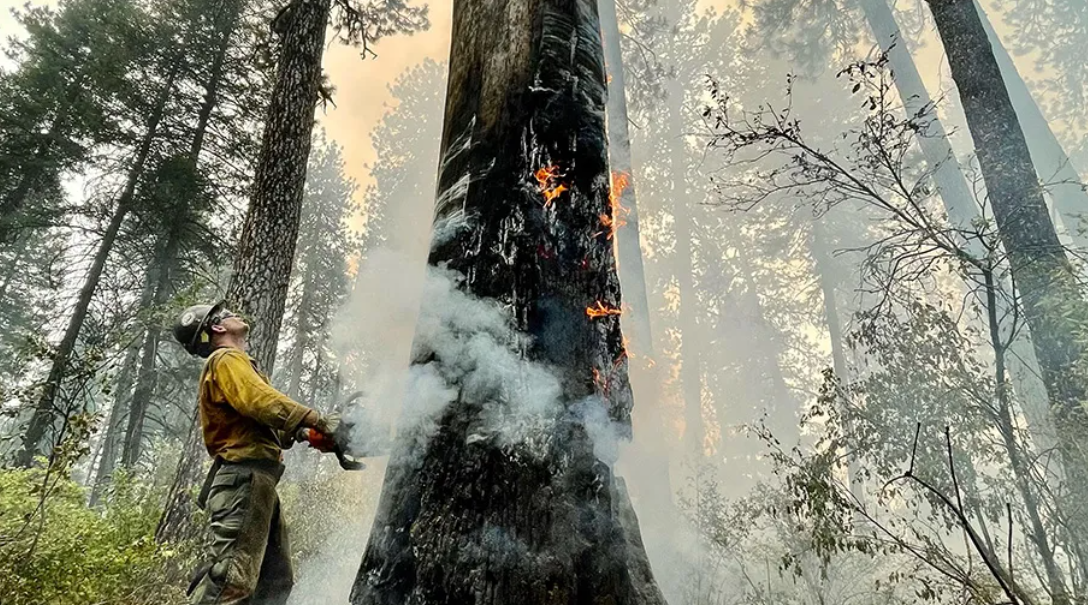
However, we still had a gigantic smoldering snag that wafted out embers from several places on it’s trunk. Almost everyone agreed that this snag remained too dangerous to fell. So, consternation continued around the fire boss’s decision to fell the snag. We wanted to let the snag burn out on its own.
Rob, who had a masters in forestry, upon our arrival advocated for no suppression on this fire at all. He argued for only monitoring because this very low intensity wildfire did a lot of ecological good by thinning out ladder fuel such as small trees and brush, reducing fuel on the ground, and releasing nutrients for the larger trees. Suppressing the fire would disturb this site and may cause irreparable damage to the soil and biome. If we must take some action, Rob advocated using “light hand on the land” concepts or M.I.S.T. (minimum impact suppression techniques). Rob likened this wildfire management technique to combustional sheep grazing in a fuel-heavy pasture that could be herded into places that needed reductions of small trees, brush, ladder fuel, and ground slash.
Even without Rob’s ecological flogging, we probably would have treated this low intensity wildfire with a “light-hand-on-the-land” attitude because, basically, well, we’re lazy. We would have “black-lined” or “cold-trailed” most of the fire’s edge. Which means we would have used mop-up techniques on the fire’s sooty edge. We would have taken off our leather gloves and hand felt the areas where the fire died out and left a sooty burned edge connected to unburnt fuel. If we felt any heat, we would have gently mixed (thusly perfecting our laziness) the warm debris with cold debris. Also, we would have burned out any unburnt islands of fuel to reduce mop-up effort (both lazy and ecologically good). Instead, our fire boss had us aggressively attack this low intensity do-gooder wildfire. We put in wide, down to mineral soil perimeter firelines like crazed Hotshots even in areas where the fire remained obviously dead out. We cut and scatter-piled brush and branches like wild whirlwinds. Our orders seemed to be to desecrate this beautiful fairyland.
Rumors had it that our Fire boss competed for an overhead position at his base and he reckoned that being an aggressive fire manager would improve his chances. But apparently he heard over the radio that he didn’t get the position. So now he wanted to hurry back and lobby the deciders to reconsider.
Rob continued to harangue Big Jay, our Squad Boss, with ecological versions of “Woodsman, spare this snag.” We all agreed that the big snag was too dangerous to fell. Predicting where the snag would likely fall seemed impossible. Rob had already gently cleared out sort of pre-firelines in a couple of resting places he reckoned the snag may fall on its own. He even placed piles of flowers as gravestones at the top of the snag’s likely resting places.
Big Jay agreed to lobby the Fire Boss by radio one more time to not fell the snag and leave a couple of firefighters to monitor the snag until its fires died deadout. Big Jay went off by himself so not be heckled by the fools’ gallery of disgruntled firefighters who opposed the Fireboss’s decision to fell the snag.
While we waited, Rob talked about how low to moderate intensity wildfires will produce tons of char that pretty quickly becomes saturated with essential plant nutrients that combine to produce that gardener’s delight: biochar. Also, these unique and valuable ancient standing snags remain essential for the biomes’ ecology. Robbed believed such snags should be left alone to decide when and where to fall. Likely they would fall during a winter’s gale. Rob related recent science suggesting that these snags may be like slow-cook crockpots where microbes simmer out extraordinary and valuable plant nutrient chemicals.
Big Jay came back and said, “Sum of a Birch! He just ordered me to fell the snag pronto. He seems to want a leadership position but right now he ain’t being a very good leader. If he wants the snag felled but everyone says it’s too dangerous, you don’t order someone else to fell it. You say OK, I’ll drop her!” Big Jay looked around at all the dropped jaws and said, “I will fell the snag. But I need an assistant swamper.”
He looked around again for the most expendable firefighter and quickly said, “L.B., I want you to be my swamper.” So Big Jay and I circled the Queen snag like pro-wrestlers sizing up our opponent. We wanted to see if we could detect any slight lean that could suggest where Big Jay should cut in the facecut. Looking from base up to the top, the snag seemed to wobble a bit, even though we felt only a minor breeeze. Rob suddenly popped up from behind the nearby gigantic nurse log, like a garden gnome wack-a-mole. “You know, recent science suggests that standing snags may be very important in promoting long term carbon sequestration,” Rob said, “They house unique microbes that produce very complex carbon molecules. These prone nurse logs can’t do that. They’re too water logged, soaked and sodden.” Then Rob disappeared.
Big Jay ignored Rob and said to me, “Let’s form a plan. I’ll try to drop her downhill. You take all the wedges and a pulaski to pound the wedges in. When I run the chainsaw, stand close to me and only and always look up, don’t take your eyes off of up there. Keep focused. Watch for killer big branches and big debris comin’ down. Don’t worry about the little stuff. When certain death starts coming down towards us, yell, yell loud, and tug hard on my shirt … When I want you to pound in a wedge, I’ll ease up on the saw and nod at you. Then I’ll be the one to look up for killer branches while you pound.”
“Here’s the most important part,” Big Jay continued, “when the whole snag starts coming down, you throw your pulaski over that big log where Rob was, so we don’t trip over it.” (Big Jay demonstrated by tossing his right arm over his left shoulder.) “Then you run UP hill in that direction. I’ll drop the saw and run uphill in this direction.” Big Jay pointed both hands uphill diverging in a horizontal “V” shape. Then Big Jay said, “Repeat the most important things to remember.”
“When she starts to fall,” I said, “I toss my pulaski over the big nurse log so we don’t trip on it (I flung my right hand over my left shoulder) and I run uphill in this direction and you drop the chainsaw and run uphill in that direction. I swung up both arms to form a “V.”
Big Jay’s radio squealed and we heard the self-regarding Fire Boss say, “Jay, I don’t hear your chainsaw working. We have finished getting ready for the helicopter to longline out our heavy gear. It could come any time now. You better get that snag down pretty quick and get that chainsaw up here or you’ll be packing out that saw.”
Big Jay just rolled his eyes and shook his head. Then he motioned towards the snag. We commenced beating on the snag with pulaskis around where Big Jay would introduce his facecut. We kept our heads up and eyes focused for falling debris. Some small embers and lichen skeletons wafted out up high, danced a bit, then their glow died. We listened to the sound of our beating. The snag sounded solid at the cutting target. “She maybe could stand for another couple of decades,” Big Jay said.
Rob popped up from the nearby giant nurse log. “You know, if you fell this snag, the impact would probably shatter it open and those creeping, dying little fires on her high caverns, which will surly die out by the end of the day, will crawl out from their hobo camps and invade the interior. The fires will destroy all those precious plant nutrient molecules. All you’ll have left is a bed of sterile charcoal.”
Big Jay snarled back, “Rob we are under direct orders from this Fire Boss to fell this snag.” Rob said mockingly, “Oh, imagine that! We destroy another ecosystem to further the ambitions of a man who could care less about the safety of workers or the habitat.” He then disappeared. But he soon popped up again. “These forests may be the important keys to sequestering atmospheric carbon and defeating Global Warming,” Rob said, “These standing big snags may also be important to a recently discovered natural, sticky, resilient soil glue called “glomalin” produced by symbiotic mycorrhizal fungi. Glomalin resists microbial breakdown and could lock up incredible amounts of carbon for centuries. Let’s be Questers for Sequesters instead of Snag Fellers.” Then Rob disappeared again.
The snag seemed to be 5 feet or more wide, so Big Jay would have to place the chainsaw in at least three different cutting positions to complete the facecut. Perhaps the snag up high had become so rotten and burned that any disturbance produced by chainsaw cuts would cause heavy branches and trunk slabs to peel off the snag and rain down on the sawyer and his assistant. We still all agreed: disturbing the snag would likely kill people. Big Jay shouted out to our crew, who watched from a few yards away, “Hey, you guys! Clear out of here! Move uphill far enough so no parts of the snag or widow-making debris can hit you! You too, Rob! Clear out!”
Source: Elizabeth Geier
I pulled down my stampede strap attached to my hardhat and pulled it under my chin. We both put in our earplugs. I took solace in Big Jay’s excellent abilities as a virtuoso Sawyer. He placed the chainsaw perfectly horizontal and began cutting the bottom part of the his face cut. He soon shifted positions, and cut the other side, then the middle in a flawless matchup. Big Jay nodded at me a few times to pound in a wedge or two to help out the saw. Mainly, I watched for falling killer debris.
Big Jay cleaned out the facecut with the chainsaw then let the saw cool down. “Ok, this is it. I make the back cut to bring the Big Kahuna down,” Big Jay said. “What’s our escape route from here and what do we do when she falls?” I repeated the plan, “I throw the pulaski over the big log so we don’t trip on it. And I run uphill this way. You drop the saw and run uphill that way.” I pointed my arms in a horizontal “V.”
Big Jay began the backcut. He had to cut deeper in the three positions. And he needed more wedging. I felt the snag shudder more than before as I pounded in wedges. Also, more debris seemed to fall although none of it lethal. Big Jay sort of tunnelled in cutting the middle section. And we piled wedges on top of each other. I pounded hard. Then I felt the snag hinge a little. Suddenly, Big Jay shouted, “Watch Out!! Big branches comin’ down!” I looked up and saw a tangle of big debris catching flames and falling towards me . . .
Read part 3 here