The Gaff
Incendiary Imbeciles #13
The dawning twilight signaled us that we had really contained this fire. Time to return to the jump spot where our mixed load of Jumpers from several bases stowed our cargo boxes. There we’d find a food bag and sleeping bag and reconnoiter a place on the slope that could be serviceable for a sleeping hootch. Then we will join the communal campfire for food, fabulous fables, and friendship. Here comes “the hour of the pearl” as Steinbeck called it. It’s the crepuscular transition between waning daylight and welling darkness when stalwart labourers ponder the challenges and victories of the day and vow their allegiance of awe and gratitude for the righteous rhythms of their eternal diurnal quotidian tasks. But Jumpers will soon sit around a campfire telling the same old stories, making the same old jokes, and embedding themselves in this sacred legacy of camaraderie.
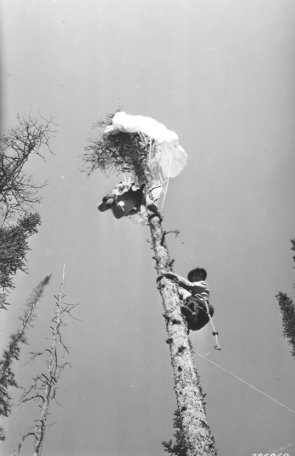
Rifling through the cargo boxes at the jump spot, I realized no food bags or sleeping bags remained. I ask a firefighter who scurried by about the possible location of more cargo boxes. He pointed to a cargo box and its parachute at the top of a tall Ponderosa pine, then he high-tailed it out of there. He must be a Rookie from another base, I thought. Then I spat on the ground.
The Sacred Jumper Rules say Rookies should be the ones climbing trees to retrieve cargo. Every base treats their Rookies with a bit of contempt and as inferior indentured servants. But if a guy from another base is abusive to their Rookies, Homies will jealously defend their own. Another thing, the usual protocol says jump partners share a cargo box. But my jump partner happened to be an older venerated veteran from another base and I know he didn’t follow protocol. He probably quit work early and took a sleeping bag and food bag from the first cargo box he came across. Another random guy must be looking for food and sleeping bags and he should help with cargo box retrieval. But he's probably a Rookie too and now nowhere to be found. So, all this yielded my “hour of the pearl?” Then I recalled that pearls form in oysters in response to irritation. Inside me I felt a gigantic pearl festering.
In the gloaming, I found the climbing gear. Also, I grabbed my own headlamp, folding pruning saw, and letdown line. A “letdown line” is a 120 foot tape-like flat rope, daisy-chained, stowed in the jumpsuit leg pocket, and used when a jumper snags a tall tree. Then it’s attached to the parachute or branch so the Treefrog can repel to the ground. After gathering this gear, I headed to the cargo-snatching tree.
Along the way, I saw another firefighter and shouted to him, “Hey, Buddy! I’m going to climb that tree and retrieve that cargo box. Could you spot for me and keep an eye on me?” He answered, “OK, sure thing.” But he didn’t immediately come over. As I climbed, he seemed to be no where to be found.
At the tree, I quickly strapped on the climbing harness. It’s a wide belt with straps that attach beneath the legs. It also has various attaching mechanisms and gizmos sewn to it. I hooked in my letdown line and tethered my pruning saw to the harness. Then I carefully strapped on the iron-shanked climbing spurs to the insoles of my boots but left the protective covers on the spurs. Dangerously sharp, climbers designed the spurs to cut through trees’ bark and embed in the woody xylem. These spurs will easily cut through your boots.
I secured one side of the climbing rope to the hook-like tightening gizmo on the harness. I attached my headlamp to my hardhat, put it on and pulled the stampede strap under my chin. Next, I approached the tree and whipped the springy climbing rope around the tree, secured it to the harness, and sufficiently tightened it. I pulled off the spur covers and then I started to climb. I flogged the buoyant climbing rope up the tree and sunk the spurs into bark. I could feel the spurs easily penetrating the bark and embedding in the woody xylem.
The climbing rope, woven hemp braided over a plaited steel cable, makes it easy to throw around the tree but difficult to cut through (making it ideal for boneheaded Rookies who should be climbing this tree).
I quickly climbed up to the tree’s sturdy lower branches, maybe 20 feet up. I executed a couple of “limb-overs”and climbed higher. A “limb-over” procedure consists of placing a shorter limb-over rope far above the branch you want to bypass and around the tree or branch and then clipping it to the climbing harness. Next you release one end of the climbing rope and scramble over the intruding branch. Then you secure the climbing rope around the tree above the blocking branch and move on. I did a couple more “limb-overs” but soon realized that it was getting dark and if I had to conduct a “limb-over” on every limb, I’d be there till morning.
Source: Fire History Society
The mid-tree’s branches now resemble rungs on a ladder, smaller, numerous, and easy to climb. So, I started “free climbing,” using my hands to pull myself up on the branches and sometimes using the spurs to dig in but other times just stepping on a branch. “Free climbing” and not using the spurs isn't the regular or a wise protocol. First, tall conifer trees always seem to be wobbling. The slightest breeze sets them gyrating and the mountains can be full of maverick zephyrs. Also, the climber’s movements and shifting weight can sway the tree. In an instant a climber could lose their grip and be tossed out of the tree. Second, one should be very selective when stepping on a branch because it could break and then the spur could easily gaff you. But, I thought, it’s growing dark and I didn’t have much time to waste on safety. So I free climbed with my hands, grasping branches while my legs high-stepped to the highest branch my knees would allow while my feet stepped on branches. Then it happened…
I stepped on a branch that I thought could hold my weight. But the branch broke. Quickly down came my left leg and speared the spur into my right leg thigh above the knee. Stabbingly painful, it gnarled me 50 feet above the ground. Reflexively I tightened my grip on the branches around me. Then I tried to lift up my left leg to pull out the spur embedded in my right thigh. But I squirmed so contorted in such an awkward tangle that I could not lift my left leg further to pull out the spur. I also worried about falling. So I rapidly wrapped the limb-over rope around the tree stem and fastened it to my climbing harness. Now I had a safer two-point secure tie-in to the tree. Then, I grabbed my left leg with my left arm and gave it a mighty tug. The spur came out, and so did a great cannonball of blood that spluttered against the tree. Inertia and my shifting balance caused me to recoil towards the tree. I desperately tried to embed the now freed spur into the tree’s trunk. But the spur encountered the dripping splatter of my slimy blood and it slipped off of the trunk. Now I had no way to slow my momentum and I slammed face first into the tree trunk. It felt like a sucker punch to my nose. My eyes watered and my vision blurred. But I managed to sink my left spur into xylem.
After a little while my eyes could focus again. I ripped open the tear in my pants made by the spur to look at the gaff wound the spur made in my thigh. I saw a little ball of muscle knotted outside the hole in my leg. Great! What could I do? But the stabbing pain had subsided to a low level gnaw. And the muscle plug seemed to stanch the bleeding.
So I climbed up to the cargo box, safely tied myself to the tree, took out my letdown rope, and tied off the box from the parachute. Once I pulled up a bit on the cargo box it relieved the gravity pressure on the parachute. I fairly quickly pruned away a few small clinging branches and yanked the parachute out of the tree, then stuffed it into the cargo box. I lowered the cargo box by wrapping the letdown rope around a branch so friction slowed the box’s descent. As the box descended, I followed it with a beam of light from my headlamp. Darkness dominated the tree's interior now. The box appeared smaller and smaller until it finally rested on the ground.
I don’t know if anybody watched me. I couldn't see beyond this tree’s foliage and I heard no encouraging voice. Lord knows I constantly swore loud enough to blanch the demeanor of any sanguine ruffian. And that should have elicited a response from anyone below. Still the conifer’s foliage can absorb sound and a slight breeze can create a smothering, rushing clamor. It’s protocol for somebody to spot for a climber in a tree, to be close by, to be of assistance, to shout out warnings and helpful advice. Anyway, by the time I got down the tree darkness had consumed most of the light. Still, I realized someone I never saw nor heard had opened the cargo box that my precarious climb had retrieved. Somebody had taken a food bag and a sleeping bag. But they did leave me food and a sleeping bag. I grew angry thinking that someone had silently watched me climb up the tree and didn’t identify themselves or even make their presence known. Also, they didn’t offer a lick of help or encouragement. But once I had safely lowered the cargo box treasure they snuck in, looted, and absconded with some booty. Like a burglar.
On the ground, I looked at the gaff wound in my thigh. The ball of muscle had retreated into the wound. The gaff appeared as a smooth slice in my leg and it didn’t bleed very much.
I walked over to the communal fire with my gear and food and sleeping bag. I found Dave on the edge of the group and asked him if we could talk alone. Dave attended medical school and had somehow talked the med school into letting him work the summer as a smokejumper.
Dave inspected my wound and said it wasn’t too bad, but it needed stitches. He confessed that he hadn’t brought his suture kit. He suggested we use some Steri-Strips from the medical belt that EMTs usually carry. I told Dave that I really didn’t want other people to know that I had gaffed myself with climbing spurs. I knew my gaff was a gaffe. It would be very embarrassing and the predictable chiding and derision would be more painful than the wound. Then I offered my needle and thread I had for repairing gear. Dave responded, “Ok, that might work. We can sterilize it with some whiskey I have.”
I got out my needle and thread and Dave poured some whiskey into a canteen cup. He put in the needle and thread. The recalcitrant thread floated on top of the whiskey and Dave poked it multiple times with his finger to try to make it sink. I rolled up my pant leg above my gaff and then placed my foot on a stump to brace my thigh. Dave tried to poke the needle through my flesh by holding my gaping flesh with three fingers of his perhaps unwashed hand and jamming the needle in with the other maybe unwashed hand. Then he would wag the needle back and forth to try to stuff it through. The wagging summoned pain. My dermis seemed remarkably tough. Finally Dave got the needle through my skin and then he drew the thread through the hole. I felt every defect in that thread as it passed through the needle hole in my flesh, and it made a god-awful vibrating sound like a badly tuned violin. Or maybe like the cat-gut violin strings remained still attached to the screeching cat and the cat continued to scream hellacious caterwauling. The thread was rough and uneven and I shuddered as I felt every twist and bump as Dave pulled the needle and thread through my skin. He jammed the needle and thread through my flesh about three more times. Each time the needle and thread set off a cacophony of garage band noise and a symphony of pain in me. Finally Dave said, “I can’t do this anymore!” He at first threw it all down in disgust, but then he clipped it, and pressed gauze and a couple of bandaids on it. “I’ll check it in the morning,” he said. He didn’t seem very proud of his work.
After eating in nautical darkness, while some stayed around the communal campfire reciting old, hilarious, well-known, wildfire exploits, I walked down to the fire and joined some firefighters patrolling the fire’s perimeter. We found the fireline holding and, in general, the fire cooling.
As some guys mopped up scabby little recalcitrant hotspots. One firefighter, I didn't know well from a different base, named Firinne said, “Hey guys, watch this! It’s still close to the Fourth of July and we can have our own fireworks!” With his shovel he scooped up some cinders and launched them into the air. He threw multiple shovel loads into the air to our irrepressible radiant delight. They did sparkle and shimmer just like fireworks. Soon their faint irradiance drifted and blended with far away stars.
Some embers wafted slowly into the foliage of a pine tree. Suddenly, the whole tree crowned out like a Roman candle, much to the delight and laughter of everyone because it came so unexpectedly. The tree stood deep inside the fire and really had no chance of sending embers across our fireline, but Firinne hustled around, checking every falling ember from the tree, worried about a reburn. Other firefighters jeered and chided Firinne but in their blissful hearts they stayed grateful for the entertainment. I continued my patrol and mopped up around the fireline. After a half an hour or so, I circled back to Firinne’s crown-out. I heard him talking to other firefighters. Firinne had spent the rest of the evening mopping up around his torched tree. As further penance, when other firefighters happened by, he dutifully recited his transgression of igniting a tree into a crown-out by launching shovel-loads of hot cinders into the air. He warned others about igniting the super dry trees by throwing shovel loads of sparks. I heard Firinne say to enthralled firefighters, “I think the trees became so dry because we’ve burned too much coal and oil and that made the atmosphere hotter and hotter. Now we have a thirsty sky that makes trees drier. It’s led to Goebbels’ Warning.”
“Who is Goebbels?”
“I guess the guy who made the warning.”
“I thought he was a Nazi.”
“Well, the Nazis knew a lot about apocalyptic catastrophes because they made so many.”
Firinne’s fireworks made me think about how some of us remain so afraid of ridicule that we try to hide our foibles and gaffes, like I did with my thigh gaff caused by stepping on a weak branch. And my scuffed nose when I slipped on my own blood. And Dave and I did with our blunderous screeching attempt to suture my gaff wound with a common fabric needle and thread. In angelic contrast, Firinne readily admitted his frailty and compensated by urging others to be more careful. Such self-aware and self-confident acknowledgement of awkward foibles makes us safer and better firefighters (all except maybe for the couple of rookies who weren’t very helpful).
I gaffed myself, that’s true. But the biggest gaffe seemed to be that I did something really stupid. Climbing that tree alone at the edge of darkness toddled to imbecilic. It became reckless, dangerous, and foolish. It could have been a script written for a Darwin Award. It was a Situation that Shouted Watch Out! I should’ve insisted that one or two other guys go with me with headlamps and made sure they paid attention, offered advice, and all of us remained safe.
So, we may drift as embers fecklessly tossed in joy against the sky. We glow and twinkle for a few brief seconds mirroring the ancient stars, but then our light dims and we return to dust. But sometimes we can cause a crown out! We do remain that dust from ancient stars that wafted through the universe until a primal pulse coagulated us into our Heavenly Earth. Now, like iridescent embers tossed against the sky we dream out and drain our brief inscrutable light. But in our fire forged moments we stay bonded by adventure, fellowship, foibles, integrity, and love. We shall ascend again in memories of those yet to come of how we kept our abettors safe, and ethically did right for bountiful ecosystems. For all the irritations we cause and the beauty we live, we all shall remain grateful, festering pearls within God’s great, endigmatic oyster shell.