Minnesota Fire Leeches
Incendiary Imbeciles #12
For those whose destiny intertwines with fire lands, the ethics of wild, ethereal, untrammeled places become mosaics of parity and belonging. For those who journey born-again or always-been, stoic and bountiful firescapes bequeath thousands of beautiful, singular memories when encountered with abiding reverence. Wildfires can be stochastic and auspicious disturbances that bring great opportunities for ecosystems, firefighters, local contractors, and other parasites.
I called him My Rock. He didn’t really resemble a rock because he talked so much. He did approximate a rock in that he didn’t help with paddling. But rocks can be essential for Boundary Waters wildfire canoe porters. I balanced an empty canoe by putting a good sized rock in the front for ballast so I could easily propel and steer the canoe from the stern using “J” strokes.
As he prattled on in the front of the canoe, often incoherent, drifting, and easily distracted, I thought a better nickname for him might be “Stoner.” Not that he did drugs. His high came from being here. So happy and so delighted with everything in this adventure. He grew up in Wisconsin, but knew the Boundary Waters area well because, as a child, he often stayed at his uncle's resort nearby the Boundary Waters.
Our Pacific Northwest Hotshot Crew had been dispatched to northern Minnesota and Michigan’s Upper Peninsula to battle escaped prescribed burns that fire practitioners ignited to improve habitat. Unexpected winds had flung fire brands far and wide. Apparently, the multitude of low intensity spot fires had irritated some fire suppression dogmatist Neanderthal in the local regional office. So this benign boon for wildlife became a campaign to suppress wildfires using techniques developed in Alaska.
Scuttle-butt whispered that these fires still did a lot of good to improve habitat and, as we closed on middle October, cold and wet autumn weather would surely KO these little spot fires. Already, frosty nights had killed off all the famous giant mosquitoes of this region, and made things comfortable and pleasant.
Source: Explore Minnesota/Paul Vincent
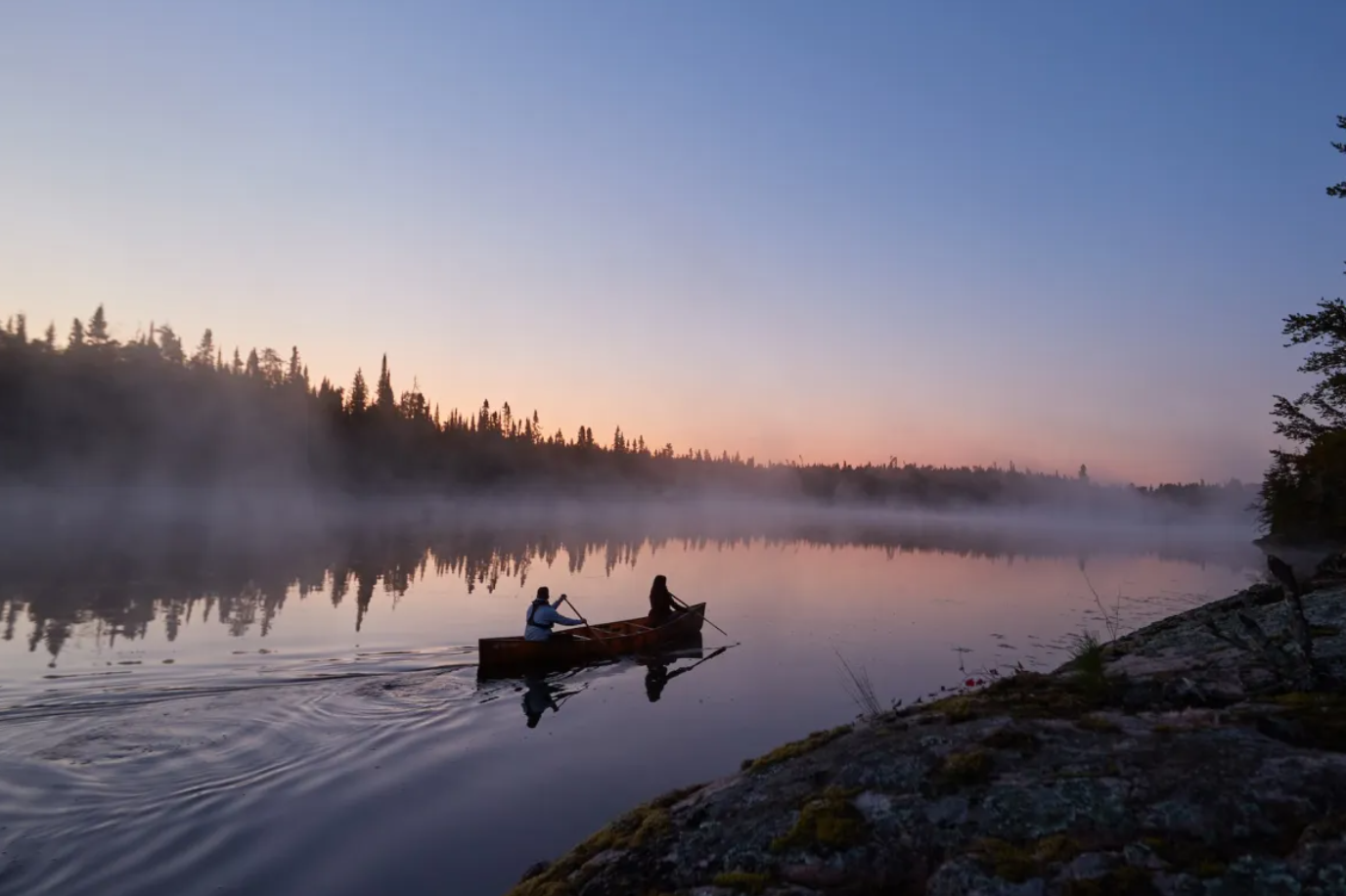
By incredible luck, our crew boss assigned me to use a canoe to portage supplies and to move pumps and hoses from one spot to the next spot on the shores of these many lakes. The trash pumps and hoses remain heavy and difficult for people to carry and drag across the uneven, boggy terrain. Almost every part of the lakeshore could be used as a portage place.
My rock sat in the front of the canoe and blithely chit-chatted away, so happy to be back in his old beloved stomping grounds. He marveled at his good fortune to become reacquainted with the sights and sounds, aromas and omens, luck and laughter, and memories and mementos that he had consecrated in his heart as a child.
Usually, the pump and hose firefighting team on shore would call me over to where they wanted to set up the pumps and hoses. After unloading supplies, pumps, fuel, and hoses, I’d put a good sized stone in the front of the canoe and paddle off. This time, after he helped unload the pump and hoses, Stoner hopped into the front of the canoe and claimed he needed to go back to where I had come from. I protested a little about it being against protocol, but we both knew I would give him a float. And he so wanted to float.
As we glided on the glistening lake, Stoner pointed out all the different plants on shore. Here we saw the vibrant maple already proudly red and orange against the green and yellow paper birch and aspen. Towering Red and White Pine shrouded the gently sloping hillocks. Brushy Balsam Fir and White Spruce cloaked the flats while Jack Pine tangled with the rocks. Blueberries, thimbleberries and raspberries glorified the understory and subsumed the snippets and remnants of fireweed, lilies, leatherleaf, and pitcher plants. Far off moose stomped in their wallows. So many duck, geese, and other water fowl floated or glided down on to the stoic surface. When Stoner would occasionally grow quiet, we would hear only the churning swash of my propelling paddle, or the far off lonely cry of a loon.
Sometimes the water seemed like an otherworldly potion that swaddled the paddle in a brooding mystic charm and then instantly dissipated. Other times the waters lay so calm and still, it seemed to be a perfect mirror and we felt as if we glided across the sky. In those perfect moments, I remembered the unquelled rapture of the coming twilight in this enchanted place. Crepuscular breezes cast tickling icy fingers followed by hints of warmish caresses. Then the gloaming would induce an awesome show. Nearly every night would bring the aurora borealis. Stunning, subtle, breathtaking and bold. Electric green and soft magenta lights danced as rhythmic curtains across the sky. Even when we slept, the aurora borealis would beckon us out of our makeshift shelters and touch us with their eerie voodoo. We stood shivering and awestruck, swathed in this cold magic. When the aurora borealis chose not to perform for us, we stood baptized in starlight beneath the immense and infinite stars that glimmered in timeless intimacy, immersing us in an assured and honorable belonging. To us the night’s stars emerged redolent as so many cinders we spent our days trying to extinguish. And here they loomed as embers from our wildfire that someone had scooped up and thrown against the sky.
“Do you remember, the first day we arrived at that lodge that became the Fire Base?” Stoner went back to talking and talking. “ Do you remember seeing that woman in the pickup truck who raced up to the float plane dock? She screeched to a stop, jumped out of the pickup, raced toward the lodge, waving a pile of papers over her head shouting ‘Hank! Hank! Hen-ry! We got the contract! We got the catering contract!’ Henry ran out and they laughed and hugged and danced for joy!” Stoner, still not paddling in the bow, cranked his head and looked at me. “They could’ve been my uncle and aunt. It’s such a hard scrabble way to make a living at these little resorts and now they’re going to make a bit of money off this fire. I’m glad, I’m glad, somebody blessed them.”
We were on the edge of twilight now, and I J-stroked into the moose wallow where we had originally loaded the gear. Stoner got out of the canoe, then he stopped, looked down at the water, and said, “Hey, come here. Look at all these leeches in this moose wallow!” He put his hand in the water. “Watch this!” He said. The leeches sensed his hand and undulated towards it. Stoner retrieved his hand before the leeches could attach. We laughed. Then he danced his hand above the water. The leeches seemed to sense his hand and followed it. “You know,” Stoner said, “these leeches are like all the people who work at these little resorts collecting pennies from cheapskate, cheese-eating anglers and arrogant tobacco-chewing hunters. The resort workers have to starve in their little mud puddles until something big and strong comes by that they can latch onto for just a little while and get sufficient sustenance. Their requisite reverence prevents them from imagining that it’s strife. They just do their jobs and remain steadfastly grateful that they have become part of this bountiful ecosystem.” Then Stoner turned and looked at me and said, "Yeah, maybe we are like these leeches. Dependent upon wildfires to give us nourishment for what our souls crave.” I knew what he meant. Our journey revealed the profoundly poignant gifts of viewing awesome celestial wonders and encountering the rapture of being near God’s hand and all its beautiful genesis. We feel the fierce fury of fires and understand their cycles of destruction and creation. We latch on as brothers and sisters in our leech-like imperative for supping camaraderie from stoic landscapes and arduous endeavors. “Yeah,” I thought, so grateful to My Rock, “we’re all just Minnesota fire leeches.”