Saving Private Cryin’
Incendiary Imbeciles #10
Private inholdings surrounded by public land wilderness have dubious origins; usually because they originate from dubious mining claims. Some private backcountry ranches provide access through their landing-strip meadows. When allowed to fly in here, wildland workers can conduct public purposes such as enhancing ecosystems. However, many backcountry ranches resist cooperating with governmental wilderness rules even though they have become very wealthy by extracting elite and exclusive hunting privileges on public lands for rich clients. One thing remains sure: during megafires these backcountry ranches often leverage incredible amounts of direct and indirect subsidies, effort, and money from public land agencies for protection.
In Alaska, there’s a regular joke among wildland firefighters saying that rather than wasting money on doomed project fires by focusing on “cabin protection” (these “cabins” can be often abandoned ramshackle shacks), it would be cheaper for the government to contact threatened cabin owners as the fire approaches and offer to buy it.
Within a vast wilderness in the lower 48 some private backcountry “ranches” constantly whimpered for more services from public agencies while incessantly complaining about the imagined waste, fraud, and abuse by public agencies. We mocked one in particular backcountry ranch’s persistent whining by euphemizing its name, calling it “The Cryin’ Ranch.”
We were sent to protect the private “Cryin’ Ranch” from a lightning-caused wildfire that soon metastasized into a megafire. We flew in a twin otter airplane loaded with our usual wildland firefighting tools, but also hoses, pumps, sprinklers, supplies, bladder bags, and catering-styled food. We packed ready for an extended bivouac.
When we saw the smoke, we realized that this ranch wasn’t just Cryin’. Directly in the fire’s path, this inholding could soon be demolished in a hellacious fire storm.
Source: Ringo Chiu/Reuters
After the plane landed in their grassy meadow, we swiftly unloaded our cargo as squad leaders barked out plans. We worked rapidly, with determined reckoning. Before twilight, we had the ranch perimeter spider-webbed with hoses, nozzles, sprinklers, and powerful Mark 3 pumps. Extra hoses and tools stood at the ready. Then we waited.
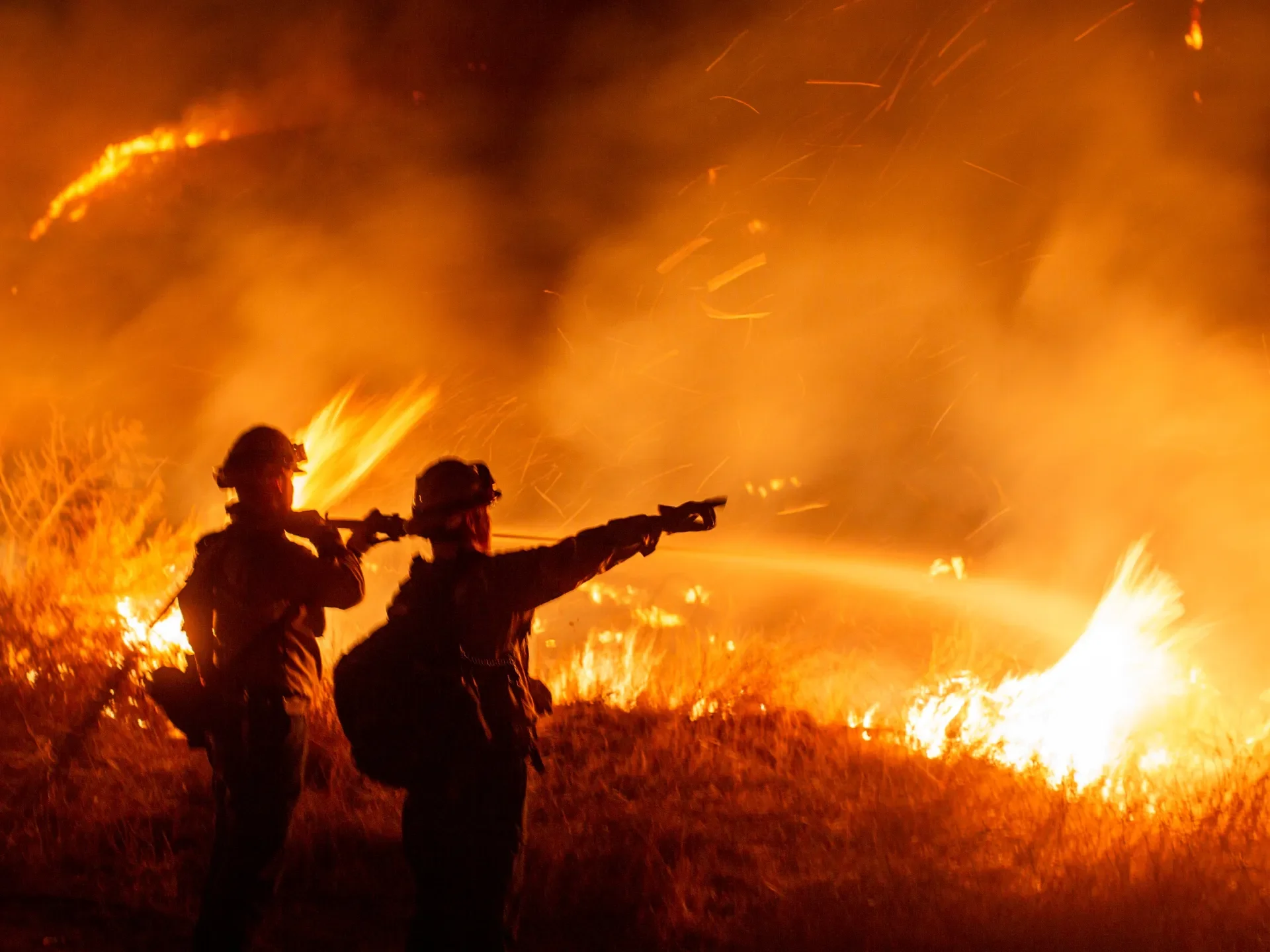
With quickening trepidation we watched that megafire stride into our valley. Like a pyromaniac rock star, it pointed to the crowd of trees, snap its fingers, and ignited the hillsides into slithering rivers of undulating embers that tumbled like molten lava. Trees fusillated into two hundred foot flame lengths. Split and sundered trees roared and howled as a haunting, hollow vortex crushed them into plasmic embers then heaved them in stinging cinder showers launched leagues ahead.
Embers pelted us like artillery softening up a target. So we ran around dragging hoses, drowning the little spot fires that embers torched off. Or, we attacked them with bladder bags and Pulaskis. On the perimeter, tree canopies ignited, tossing more cinders into the grassy meadows that we defended, making our predicament more menacing.
For a while, we felt overwhelmed by the intense released energy ominously coiling around us. As we stepped back in a prudent retreat, some of the abandoned hoses steamed, smoldered, and caught on fire. A few hoses burnt all the way through and when water-charged, flopped around like wounded snakes squirting venom.
We endured crushing heat as we stood our ground persistently hosing down recalcitrant flames that encroached on our little island of life. But we felt like we were trying to sell popsicles at the gates of Hell.
Then we decided we had surrendered enough territory. So we held fast at the corral fences while the fire raged around us. Flame lengths, two or three times the height of the surrounding Ponderosa pines, salvoed in white-hot intensity. A hell-roaring cacophony blared as the fire devoured hillsides and vaporized cumulated organic debris, foliage, brush, and trees.
The crew at the cabins smothered with water the torrent of cinders raining down and stopped the cabins from igniting. The crew by the pumps kept the water surging while drowning nearby spot fires conjured by the ember storm. I battled the fire mainly with the crew on the perimeter. Sometimes I stood on the searing edge of the fire, aiming my nozzle torrent at the heart of encroaching, whirling talons of flame that snatched and gobbled innocent life. Sometimes I pulled the hoses for other nozzle workers. Other times, with Pulaski and bladder bag, I charged an invading hail of cinders that parachuted in and then metamorphosed into marauding, berserking, whirling spotfires.
Hundreds of years of sunshine had created this beautiful forest. Now the hulking megafire imploded it back into the plasmatic power of the germinating universe. As the tsunami of force came hurling against us, we stood as the rock upon which this wave of energy broke and sundered.
We endured as that force surge against us, threatening incineration and annihilation. Then as we stood resolved and steadfast, we felt it stutter, stumble, and shatter. The firestorm staggered away in rivulets of broken might. This consuming, gyring conflagration split around the ranch while we wee wheedling trolls squirted water at it.
The remnant fire howled and heaved. It raged and stomped out to the surrounding hills to gain strength for its charbroiling faculties. Then it continued to vaporize and incinerate trees into cindered stumps and snags. It left a wake of docile ash and smoking tuffs reeking out its exhausted rampage.
We had survived in our little wet refuge. We were saved by the tiny rivulet stream that burbled along the edge of the meadow. We were grateful that the tiny creek never went dry during our perilous fight. In various places, we had thrust into it a number of wide intake lines with foot-valves that slaked the roaring thirst of our loud, penetrating cacophony of trash pumps.
We saved the cabins, the corrals, and most of the perimeter fences. The meadow grazing area, which also served as a landing strip, rippled its lush grass, only slightly freckled with ashen spots. It remained usable and durable.
We worked deep into the sooty tumble of dank, dark night. The twilight sent a cooling crepuscular breeze that caressed us with char and cinders and stanched us with the nauseating smell of a funeral pyre. We trudged on while our thoroughly soaked boots, each weighing a ton a piece, spat out a pint of water with each step. We doused any hint of heat with gallons of water and mopped up the remnants of all the little spot fires that had so cheekily challenged us earlier in the day. Soon we found the frosty cold of the cooling night as painful as the intense heat at the height of our fire fight.
Finally, the ranch employees, who had stayed in the center corrals with the horses and pack mules while we broke the back of the megafire, called us in for dinner.
As we tiredly trudged in, we rejoiced at our work, we remembered all the peril, heroics, and camaraderie that made our hearts soar. We recounted the hilarious calamities that tried to bully us as we stood in searing heat, battered by whirling ember storms, and pelted by a furious fusillade of firebrands. We kept fighting as we stood under flamelengths hundreds of feet tall. We DID save that ranch while manacled in the maw of a mendacious Malstrom! We lost some hoses and some sprinklers and a few sections of perimeter fences, but all in all we saved the ranch. And we swaggered very happily about that.
The ranch employees had heated up our pre-made dinners that we had flown in. They seemed glum, sullen, and surly. Some of us had a tad of resentment because they stayed at the central corrals with the horses and hadn’t helped out with the firefighting. To some of us, they didn’t seem to display the requisite gratitude we expected for saving their private ranch. In the chow line, we imagined that they dished out more insults than food. We even speculated they hoarded the lion’s share of victuals for themselves. At the time, many of us assumed that they displayed the perennial resentment that often occurs among wildland workers.
Elite wildland firefighting crews often take on the persona of a winning football or rugby team. They can become rowdy, swaddled in hubris and self-grandiosity. Sure enough the job remains dangerous, arduous, and requires a lot of strength, endurance and complex thinking. But so does almost every other wildland job. It’s a little much for fishery workers, biologists, surveyors, trail and bridge engineers, and wranglers to watch wildland firefighters, preening and strutting like peacocks.
Imagine wildland firefighters trying to survey animals, birds, and plants in grizzly country. Imagine them snorkeling perilous rivers and streams trying to identify and count juvenile fish. Imagine firefighters attempting to chip out trails high along sheer cliffs, or engineering backcountry bridges. Imagine watching wildland firefighters pack and lead horses and mules through the hinterlands without conjuring a hilarious rodeo.
Even that day we chased away the megafire from the ranch, the wranglers actually had one of the most important jobs. They calmed the horses and mules in the central corrals. If they weren’t successful at soothing the horses, it could’ve harmed firefighters, perhaps fatally, as the terrified animals ran wildly amuck, and firefighters, reflexively, would have tried to save them.
All wildland workers do public good and remain not paid sufficiently for all the value added they give to public lands.
Over the years, I think I’ve come to realize the reason for the sullen sadness of the private ranch wranglers. We firefighters came into this place and put up an awesome fight. We split the megafire and saved the ranch. The ranch remained the beautiful green jewel in that valley. But the megafire burned severely and intensely across the surrounding hills. Now the landscape presented fifty shades of gray and black. Now burnt, tortured trees seemed to stagger about with no foliage or branches smaller than three inches in diameter. Trees had cracked and exploded leaving splintered trunks looking like ghastly gravestones wisping shards of smoke. No brush nor grass left a hint of its prior presence after this visitation from Hell. Some tufts of ashes still glowed in a throng of demon eyes across the scarps and hillocks. So maybe the Private Cryin’ Ranch wranglers seemed to some of us to be ungrateful, sullen, or rude because they felt shock, trauma, and sadness. Their beautifully green, elfin, enchanted forest that surrounded their magical Shangri-la had been mutated into a bleak misery. They still had their green resplendent ranch. But now it posed as a stalwart ark that sailed on a gray, stoic, malignant, and indifferent sea.
It snowed that night. Early in the morning, the ranch wranglers rousted us from where we slept in the barn. They fed us the waffle breakfast we had flown in, and quickly dispatched us to cut and peel enough recently burned and killed lodgepole pines to repair the perimeter fences that had burned in the fire. It remained cold and miserably wet throughout the day. We trudged, soaked to the gills, freezing and cursing. Again, our boots puked up a pint of slush with every step just like the night before. Numbing cold chattered in every moment. We were not equipped for this weather because we expected extreme heat. But wildfires, especially megafires can form their own weather. It snowed and sleeted as we cut the large pole pine and dragged it to areas where we peeled and repaired the fences.
We worked from the early morning until the late afternoon and even repaired some fences and corrals that had not burned, but had become old and would need replacing in the next few years.
At last we saw the Otter airplane circling above us getting ready to land. We had to hustle to get our gear and everything else that we could take back with us. We were being dispatched to other fires. Some of us would be dispatched to new fires kicked up by this change in weather. Others would follow this remnant megafire as it limped and whimpered along. The snow and temperature drop had taken a lot of violence out of it. The fuel moisture recovered to be relatively high now, and the winds remained slow and light.
Now, as a widespread, low intensity fire, it gnawed at random patches of brush and small trees. It scavenged a lot of fuel, but wasn’t damaging big trees. This ferocious, ravenous giant lion of a fire had spawned a lot of little kittens that pledged to do some good for their habitat.