Cheery Creek Ember Storm
Incendiary Imbeciles #11
Wildland firefighters remain united to safely and ethically work together to improve ecosystems and insure that no one is left behind. During burning out operations, these skookum fire practitioners, akin to ethical shepherds, make fire-prone ecosystems fire-permeable by herding low intensity fire into places where fuel can be safely consumed. But all bets are off when you can’t properly predict the weather!
We rendezvoused over a big meadow jump spot, three jump planes from different rival jump bases. The pilots coordinated a flight pattern in which each plane followed another plane in a great oblong circle. Every minute or so one could hear: Pop! Pop! Another two jumpers exited the plane, joining the parachutes in the air drifting down to augment firefighters on the ground.
As initial attack specialists, we jumped the Cheery Creek fire. We knew this incident would be festive and cheery, and have all the elements of the Scottish games with plenty of stone throwing and log tossing. Better yet, there’d be no bagpipes. And we wouldn’t have to wear kilts.
The wildfire spread out on flat and easy terrain among a moderate amount of fuel, including sporadic clumps of trees and clustered brush. The fire had happily hopped and skipped through the area leaving some burned islands, amid a sea of unburnt terrain.
The three jump planes lined up in tandem again coordinating their great circle. This time racing in 100 feet above the ground, they dropped cargo in tandem each plane shoving out a couple of boxes over the jump spot. Our cargo came in hot, low and fast. The little cargo parachutes popped open as the cargo boxes almost immediately landed. And almost all hit the ground. A few straggled into brush or low trees.
We gathered our tools from the cargo boxes and poached some food to survive the shift. After a quick meeting with the fire boss, Squad Bosses collected their firefighters and each crew took a different section of the fire.
We had the best ingredients for completing fast and superb wildland firefighting hotline. Competing against our sister crews, gave us all focus and summoned reserves of nascent strength. We could not abide the disturbing thought of being bested by our bestest buddies and competitive rivals. In our section, chainsaw teams quickly cut a swath through low hanging branches, small trees, and the clogging masses of brush. Several swampers rapidly cleared severed fuel, hauling it away to easily produce the requisite mineral soil fireline.
We pulaski pounders followed close behind swampers creating great rooster tails of airborne duff clouds and swirling dirt debris. We rapidly produced our sufficient fireline, often much maligned as “jumper line” by Hotshots who pridefully construct wide and immaculate "Hotshot Highways” to impress lowly Sector Bosses. Although jumpers may be accused of being weak, feeble, infirm, and idiotic, which all can be true, our jumper firelines remain durable and serviceable and mostly successful. They abide functional for “Light-hand-on-the-Land concepts and MIST (Minimal Impact Suppression Tactics). These jumper lines stay less impactful than Dozer lines or even “Hotshot Highways.”
Soon we had the fire’s estimated 10 acres adequately lined. I heard our fire boss triumphantly radio in our quick containment of the fire. He seemed to personally know the team who dispatched us and had jurisdiction over this wildland fire. He also described the considerable smoldering and unburnt fuel that remained within our fire perimeter lines.
The radio chatter turned to the coming weather front, which remained hours away. They discussed whether there’d be any wind disturbances before the weather front arrived. We couldn’t possibly mop-up all the hot spots and secure the lines before the weather front slithered in. Any breeze would blow embers across our firelines and rapidly expand the fire.
Our Fire Boss suggested that we burn out the unburned fuel inside our perimeter lines. This would give us a better chance of completely controlling the wildfire. We should do this before a predicted weather front comes in tomorrow. Dispatch agreed. We also requested more fusees and possibly driptorches to be dropped as cargo as soon as possible.
We scampered back to the fireline and cleared any troublesome areas and spread out concentrated fuel that might burn too hot. Very soon a fusee-loaded plane announced that it flew about 30 minutes out. We could start the burn out now.
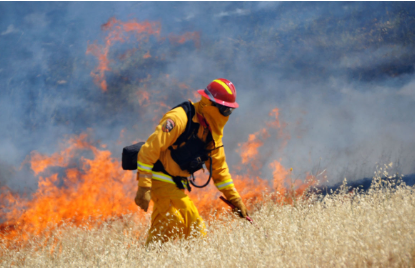
Source: Linnea Edmeier/KQED
Almost all of us carried four to six fusees anyway. Although aviation rules forbade us from openly carrying fusees inside aircraft, we hid them in our jump packs, out of view. We considered them essential safety tools to prevent entrapment because we seemed to be routinely ordered into situations that could easily lead to entrapment.
To begin the burnout, we sorted ourselves into igniters and slop-over guards who must control any cinders that ambled over the line. The guards could also provide the igniters with more fusees as needed. So we started our chevron-styled burn patterns. The crewmember deepest in the burn area ignited first, walking at a slow, deliberate pace while three to four yards below and three to four yards behind another igniter followed. We constantly communicated by shouts to amend spacing and pace.
When the jump plane dropped the cargo of fusees we knew we could accelerate our ignition effort. When guys lugged in arm loads of fusees, we knew we could beat this fire.
About an hour into our burn, which appeared textbook and smelled like victory, we felt a little breeze that flurried some leaves on the brush and made the tall pines dance. We igniters looked at each other and hoped this rogue zephyr would soon abate. When it did, we relaxed and then avidly returned to igniting and advancing the burnout.
Within a few minutes, we heard a swooshing sound that rumbled from far away trees and shrubs. Clapping and knocking, these boughs and brush swayed as a strong breeze trembled them. Then smoke, beckoned by the wind, raked across the landscape waist high. Twigs and gravel, driven by blustery gusts, pecked at our boots.
Within the fire parameter, burned areas suddenly awakened and unshuttered a multitude of red angry eyes, glaring malicious and malignant. Smoking grass tuffs, clumps of conflagrant duff, and smoldering litter revealed deeply menacing crimson gaping grins. Reanimated, they girded their loins, eager to do battle.
Fire brands, launched transversally, weltingly vicious and homicidal, impacted with painful electric jolting stabs, as if hornets had stung. They signaled more pain to come.
The tempest’s intensity increased and a demonic cacophony bellowed out of the broiling landscape. The wind raged. Fire vortexes whirled. Tree branches cracked and sundered. Rapacious flames instantly devoured copses of brush in voracious cackles.
A great wail arose from the perimeter line. Plaintive pleas, like anxious mothers imploring their endangered children, sounding urgent, loving, and sympathetic, “Get the Hell out of there, you morons! You wanna be barbecued?”
We coughed and gagged wretchedly as we tied bandanas over our noses and mouths. Throttled by smoke and garreted by soot, I became disoriented. My eyes and nose streamed. I couldn’t breathe. Any attempt to inhale slammed shut my trachea. I whizzed and retched. Through the horizontally vented smoke and dust, glowing embers flew, looking like tracer bullets, or exploding flack.
My vision blurred while the roar of incineration accelerated. I lost contact with my fellow igniters. Panic caused me to trot a few steps. Then I realized that running would likely cause me to trip and fall.
Although the wind-driven, smoke-laden air nursed a spawn of embers, it had not yet transformed to lethal heat. But I couldn't shout out to crew members and I couldn’t hear them. As the ember storm intensified, I couldn’t perceive whether I hustled through a burnt but safe black area or if I transgressed through inimical unburnt fuel ready to burst into deadly flame.
Stinging embers, blistering cinders and my cough-clogged confusion prevented me from discerning the direction of our safety zone where we cached our cargo. The horizontally projected embers now pelted like hot lead shot.
I thought about entrapment. But it would take time to deploy my fire shelter. And while I scampered, I couldn’t detect the amount of yet unburned fuel that could possibly shake and bake me while I cowered inside my very thin fire shelter.
Through the curtains of smoke, I could see a wall of flames a few yards in front of me. This meant that place had a lot of light grass fuel burning and cooling quickly. This would be a better place to deploy a fire shelter.
As I approached the area, the wind whirled, whipped and changed directions. Then it spun towards me. I hopped through the flames. Like a circus animal. At my feet lay a carpet of black glowing soot, rapidly dying in the wind. I walked a few paces on the cooling ash along the fire’s edge. Then suddenly the flames whirled again and came towards me. Again I hopped through the flames. This time, it seemed as though I stepped through a door.
The wind blew fresh and clean. My eyes and lungs rather rapidly healed. It took me a little while to figure out where our safety zone and cargo sat. Still sweating from heat and fear, I walked slowly, exhausted from exertion and strife. Also, I began thinking up plausible excuses for becoming lost and not keeping up with the evacuation.
When I arrived at the safety zone, a few firefighters sat or lay on rocks and cargo boxes and grunted callous greetings. They seemed irritated at losing the fight. Some firefighters had already gone out to monitor the growth of this wind driven firestorm. No good news. This fire wasn’t so cheery and I never saw Cheery Creek.
I didn't know if others found it challenging to scuttle out of the burn out area. Fearing ridicule and derision, I didn’t bring it up. It slowly dawned on me that none of them realized I didn’t make it out with them. They had forgotten all about me!
Then the wind shifted. The annoying ember storm boogied over to us. Although we felt safe in the safety zone, the perpetual painful pelting of pea-sized char caused some crewmembers to open and crawl inside their fire shelters. Most of us just sat on large flat rocks and defiantly withstood the punishing cinder stings as an unjust but inevitable flogging.
Burn holes freckled our green pants and yellow Nomex shirts as if swarms of flaming hyperheated demonic locusts had gnawed on our flame-resistant garb and fire packs.
I thought about some of our hectoring high-up hierarchical supervisors’ constant harangues that threatened firings of those who dared to waste government money by opening a fire shelter when it wasn’t necessary. Sheesh-Louise. They should come out here and try being a fire whirl-wind magnet for a while.
I learned later that high-up honchos tried to pin fault of this now project fire on our fire boss and our burnout operation. But I had stood close by the radio chatter and heard the discussion of the weather front coming in and the agreement that burning out the fuel remained the best option.
The weather prediction ended up being wrong. Yet, as usual, glory trickles up, but blame stomps down.