Incendiary Imbeciles #14
by Letter Burn
Safety first. Safety for group unity and cohesion often requires subordination to a chain of command. Sometimes firefighters aren’t in positions to provide safety for ecosystems. But they can voice bottom-up instincts that declare mutilation of ecosystems remain ethically wrong, no matter the imperative.
The fire functioned like fusee enhanced clockwork. Every morning between 10am and noon the inversion lifted and the fire, inhaling fresh air, became angrily alive and commenced roaring and rampaging through hundreds of more acres, creating 200 foot flame lengths, and chasing firefighters trying to scurry away.
Called in to reinforce crews on the Long Thumb Complex Fires, we jumped as a 20 man crew into a huge meadow that also hosted the fire camp. We hit the ground in style and promptly packed up all our gear, ready to leave. Next, we hustled over to a pickup truck where several camp workers handed out sack lunches complete with extra helpings of disdain and derision. Then we marched off to greet this fire a good morning before it roused for a fight.
Resting and docile, the fire remained marinated in a shroud of smoke maintained by the morning’s inversion. Starved of oxygen, it behaved rather benignly for now, likely studying our weaknesses and foibles, planning its attack. Back in those days, only a few people had radios. Because I marched (promenaded) close by our Crew Boss for this Duck Soup excursion, I heard most of the radio chatter. As skookum as they come, our leader Konstance now kept his cards close to his chest as he communicated with the Sector Boss.
After haggling with the Sector Boss over where we should be positioned, Konstance picked up the pace and we tried to keep up. After awhile Konstance said to us, “They want to send us into probably the most dangerous area to tamp down spot fires that cross the dozer lines. You know, back home I’ve followed the radio chatter on this fire for days. Every day they construct miles of dozer lines, including secondary and tertiary dozer lines. This area has become spiderwebbed with dozer lines. And it never works. Every day between 10am and noon after the inversion lifts, the fire revs up and blows across the dozer lines. Today they’re hoping that with extra reinforcements they can stop it. But it’s not little spot fires that break through containment when embers eek across the line. The whole fire with its hundred foot flame lengths blows across. Even when they’ve created a fireline four dozer blades wide. There’s no stopping it. Now the overhead wants to pile in more people imagining that a firefighter can beat down a wall of flames as high as a Ponderosa pine. They fixing to get firefighters killed.”
“From the jump plane, I saw a couple of safety zones the dozers carved out. Let's go there. We will be safe there.”
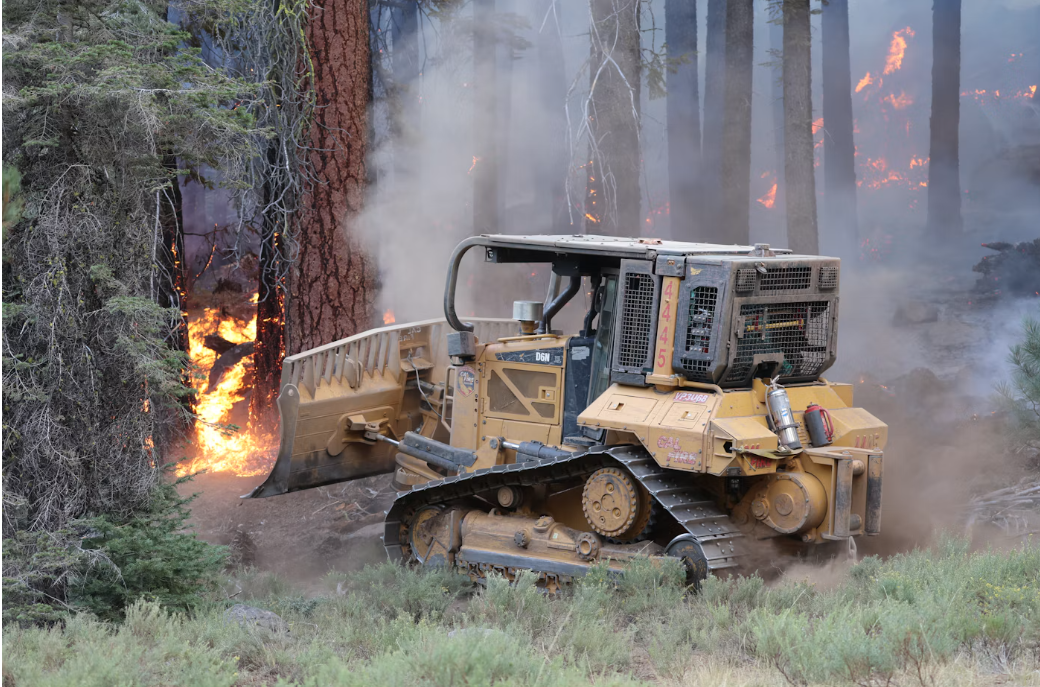
We stumbled along in a dozer line, stepping over broken lodgepole pine tree branches and trunks, avoiding torn up tree stumps, root wads, and piles of dirt. Down the steep slope, we could see through the burned Lodgepole pine skeletons and saw more kerflooey dozer lines spanning as spiderwebs and stairsteps on this once verdant forest. The dozer lines could have resembled tree growth rings, but they tallied the daily Sisyphean fruitless failures of the futile dozer lines.
The scene reminded me of those Medieval paintings depicting the martyrdom of Saint Sebastian. Ordered to be executed by archers, he survived. The paintings usually show him tied to a tree with about 100 arrows stuck in him. He looks like a pin cushion. Those dozer lines resemble the Medieval paintings’ arrows: overdone and ineffective.
The fire burned through a roadless area. Dozer lines look like roads, and now this place had more roads than a cityscape. Also during the prior days, fire crews created a lot of the severely burned areas when they attempted containment by burnouts and lost it. If the Fire Bosses had just let the fire burn, within a decade even severely burned over areas would be providing shelter, mast, and food for thriving wildlife. Nutritious brush would be attractive to deer and elk, providing rich nourishing fodder from the fire’s release and transformation of essential elements and critical chemicals from the resting treasure of forest litter. This boon of char and ash would stash plant nutrients as naturally made biochar and providing fertilizer over the next decades. At age 30 most sojourners to this area would have proclaimed it a young, healthy, and beautiful forest, even though the trees would be half the size they would attain at maturity. In 120 years, the area would contain as much carbon as it had before it burned. And, as one of many subsequent long ago natural wildfires, it would not be remembered except in the mottled fire scars within the cat-faces of ancient trees.
This now defaced area, senselessly scarred with a plethora of dozer lines, had just endured cruel and unusual punishments. These renting, road-like deformities will continue to erode and mangle the steep slope over decades, choking ephemeral streams and obliterating a multitude of micro habitats.
After the singularity, when perfected robots sojourn to this area and observe these illogical dozer line scars, their digital hearts will break. And they will conclude that annihilation of humans remains the logical thing to do.
Konstance abruptly strode off the dozer line and into a dozer-gouged wide space about the size of a football field, a safety zone. Konstance assured us we would be safe here. Soon the Sector Boss radioed Konstance asking him if our crew occupied our assigned position. Konstance evaded, “We are in the position we should be in.” The Sector Boss replied, “But is it the area I assigned you to go to?” They bantered and haggled back and forth for a bit, with Konstance always asserting that we stood in the place we should. At last the Sector Boss said, “Ok, I’m going to walk up and meet you.” Konstance signed off and then said to us, “Alright, let’s hurry up and go to another safety zone.”
We scrambled out to another staggering march on another dozer line. I thought about how arrogant and jaw-droppingly incompetence this whole operation had become. The overhead must be spending millions of dollars on attempting to suppress fire in an area that should stay remote, roadless, because it remained marginal for timber use. Perhaps it could become designated roadless. So did some resentful timber-beast overhead vindictively whip-scar it with pseudo roads?
Another element brewed here. I recognized it when listening to the Sector Boss who seemed to condescendingly converse over the radio with Konstance. He hinted of his notion that Konstance conjured insubordination and possibly there would be consequences. The Sector Boss didn’t seem interested in Konstance’s opinions and bottom-up observations. This Sector Boss appeared more interested in dominating and pulling rank on Konstance. At that time, wildland firefighting hierarchy began transitioning away from the old style worker/boss relationships. Old style synergy includes informal interactions, mutual respect, open communication, and appreciation for opinions and observations. The crew/boss system valued bottom/up input into decision-making. The new Incident Command system, derived from the military, focuses on top/down decision-making. They made a point of not coddling opinions from the bottom.
Perhaps another ingredient impinges here. The most heuristic and galvanizing wildfire experience of the top overhead on this fire happened in the 1970s when wildfires weren’t so ferocious as they have been since the middle 1980s. During the 1970s, fossil fuel pollution produced CO2 (the major cause of global warming) and aerosols, such as sulfur dioxide, which reflected back to space a lot of sunlight. So global temperatures of the 1970s slightly cooled and wildfires burned less intensely and behaved more docilely. Fire Bosses of that era got used to wrangling wildfires pretty easily. Once cleanup of sulfur dioxide aerosol pollution became effective during the late 1970s and early 1980s, the atmosphere continued to be stuffed with even more industrial and transportational CO2 and all Hell broke loose in wildfire land. But, many of the top level megafire bosses still “disco-ed” like it was the 1970s.
As we scuttled along the dozer line we encountered fire crews in fighting positions, ready to do pugilistic battle against the advancing fire. Konstance stopped momentarily and talked to some Crew Bosses about the predictable fire behavior and likely events coming as the inversion lifted. Konstance urged them to head to the safety zone now. After hearing Konstance’s sales pitch, our crew became born-again proselytizers to any firefighters we met as we walked along. “Brother, Sister! Save thyself! Find the path to salvation and the Safety Zone!”
We didn’t get any converts. So we left the dozer line and climbed a steep slope to a vast boulder field with very little fuel strune about. We perched on great rocks, waiting for the show to begin. We could see a firecrew a couple hundred yards below us picking out small branches and needles out of the dozer line. We reckoned they did the equivalent of rearranging the deck chairs on the Titanic.
Soon, we felt a refreshing breeze lift the smoke marooned in the forest below. The dull gray that tinged the sky began to dissipate. The constant clang, clang, clang of the cats and dozers seemed to go up a few octaves. Smoke billowed out of multiple spots in the landscape. Sporadically, trees crowned out. Smoke columns formed and commingled, merged, and then headed for the stratosphere. The radio chatter turned hysterical. Konstance looked at us and asked, “Why are they so surprised?”
Source: Line Gear Fire & Rescue Equipment
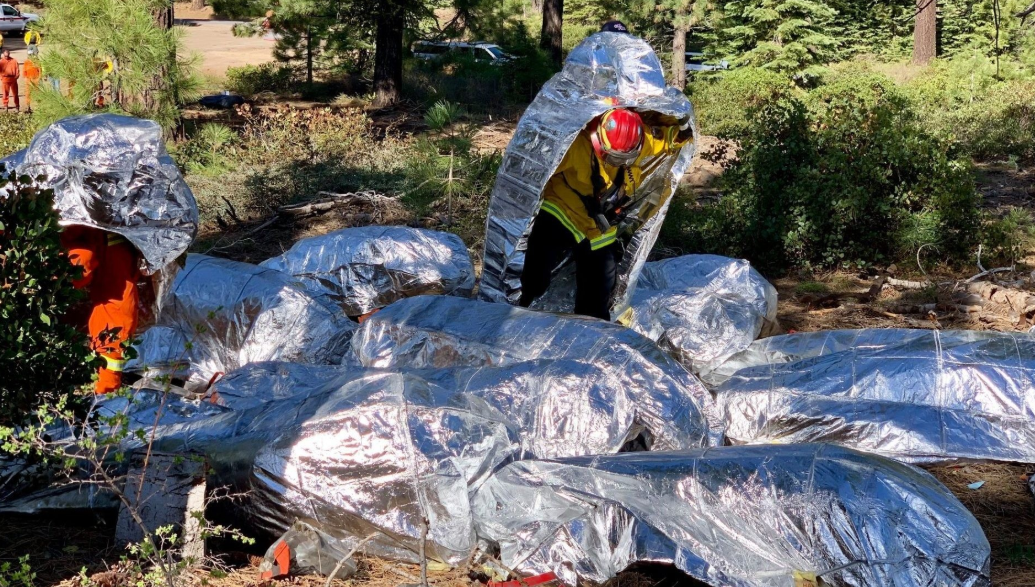
Sparking embers slowly drifted down on us. We could see the crew below us scampering around trying to put out spotfires in the dozer line. Many of us dug out the sandwiches we got that morning and enjoyed the show. As the wind increased, embers began to pelt us. Essentially harmless, these cinders found little fuel to burn in our rock pile. Still, some embers burned spots on our clothes like branding irons. Some stung like hornets. Most annoyed like mosquitoes. The ember shower on the crew below us didn’t appear worse than we received. Yet suddenly the crew began deploying their fire shelters. Once they prostrated, we watched them writhe in their shelters like butterflies in their chrysalis. One poor fellow chose a spot too close to flammable debris and when they torched off, his writhing looked like disco moves.
We sat above on our perches eating our sandwiches, enduring the cinder hornet stings and ember branding and never thought about deploying our fire shelters. Our overhead trained us to reflexively be sensitive to “wasting taxpayer money.” Once deployed, the fire shelter must be thrown away. For the cost of replacing our 20 fire shelters, the government could probably rent another half an hour for one of those dozers.
As the wind waned the area filled with smoke which reduced visibility. We could see the hazy dull red of trees crowning out and the misty red outlines of the crown fire’s front. And we could barely see the deployed fire shelters below us. After a while Konstance, who had been on the radio constantly, said, “Come on guys, let’s go back to the meadow where we jumped. They want us back at the base for initial attack. They’re sending transportation.” So we clambered down the boulder field and back onto the cat line. As we walked by some of the fire shelters, a few firefighters cautiously peeked out. We hiked back to the meadow and fire camp. We got some more sandwiches, stood around eating and joking. After a while, a school bus showed up and we returned to our homebase.
We learned later that that fire had a record deployment of 120 fire shelters. Only a few minor injuries reported. Whether that fire held a record for density of roads or mileage of roads per acre remained not mentioned, noted, or maybe even not noticed.
I don’t know whether any places on that fire where firefighters deployed their shelters had significantly more flame and heat than what we experienced. But, although we tried to talk fellow firefighters into going up to the safe bolder field where we stayed, in the end I’m glad those fire crew members followed their bosses’ orders and remained where their boss ordered and deployed their fire shelters when commanded to. We followed our commander and so did they. Crew bosses remain more experienced and better trained. We all did the right thing.
In critical situations the chain of command must be followed for safety’s sake. It saves lives! A fireline is no place for freelancing.